The first, invitation-only wave of the Longlight Online closed beta is running. The game runs in the browser, on the player portal: sign in, press Start the game, and you are in – there is nothing to download or install. You need a desktop computer with an up-to-date Chrome, Edge or Firefox (WebGL2); phones and Safari are not supported. In Chrome or Edge you can also install it as an app, and it opens full screen. The game is free. There is no public sign-up – the first wave is invited personally.
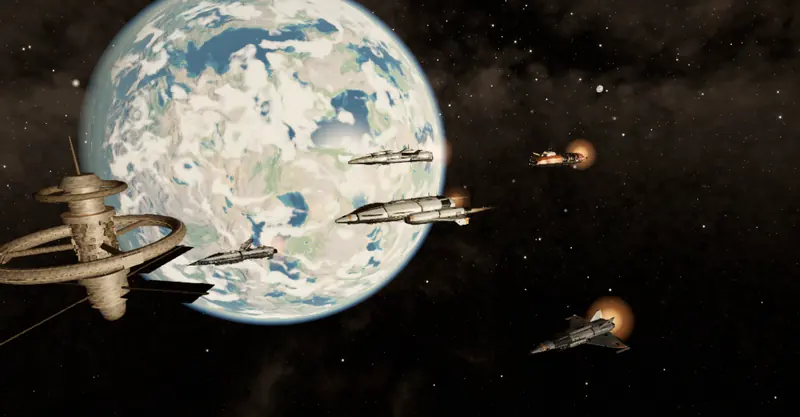
Longlight Online has a whole new fleet – ship models by Viktor Hahn (CC BY 4.0) and Quaternius (CC0), reworked for the game (full credits in the game). You start in the Velox – a nimble starter ship with a turret on its back – and the shipyard sells four more: the Accipiter interceptor, the Hasta frigate, the Speculator scout and the Remulcus rescue tug. The sky is busier, too: independent pilots fly Veloxes in six paint schemes, miners work in yellow Talpa mining barges, traders haul containers in the Portitor, the System Patrol flies the Custos and pirates come at you in the Rapax. In patrolled space you may spot a Federation Bellator battleship – it is on show at the shipyard, but not for sale yet. If you already had a hangar, it carries over: credits, cargo and progress are untouched. And player ships now burn with a warm amber exhaust.
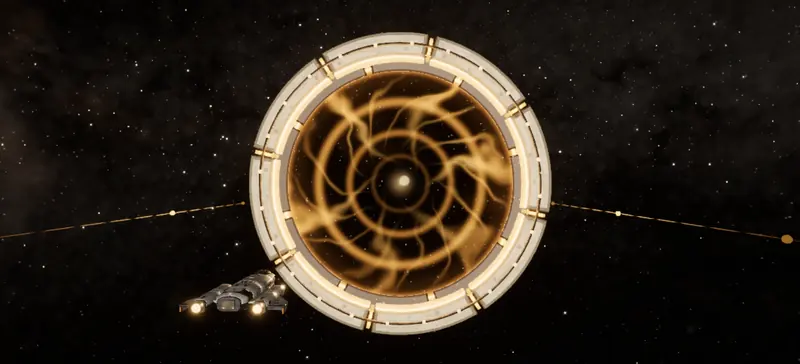
The gates got another round of polish and look better than ever: on arrival your ship now flies out of the membrane head-on, against amber backlight. And Ctrl+H is photo mode: every panel disappears, the game pauses and the camera is free – Ctrl+H or Esc brings everything back. There are also a few small things you will have to discover for yourself.
The gates got a form of their own. A Lantern gate has two counter-rotating rings with amber seams, a three-legged mount, a needle, and a membrane that opens onto the sky and the sun of the destination – its colour is the colour of that star. It wakes as you approach. The jump itself, the Long Light, is a short scene: lock, build-up, a held breath, the discharge, a warm veil – and on the far side your ship flies out of the membrane. Space, Esc or a click skips it.
Smooth ship edges, light rays from the star, a restrained lens flare and a warm colour grade. Explosions now have a shockwave, sparks and slowly drifting smoke; hits spark where they land, and missiles leave a trail. The combat camera (C) works like a telephoto chase view: your ship low in the frame, the pirate above it – a ship, not a dot. Quality has three settings: low, medium and high.
Version 0.2.0 brings the core together. Lock on to a target and fight with a laser turret, a missile launcher, a shield booster and an afterburner. Pirates show up on the scanner first, then hail you on the radio – Pay, Drop the cargo, Run or Fight – and their gang remembers what you chose. Trade on markets whose prices follow the stock, take courier, bounty and survey missions, and upgrade your ship at the shipyard. If you are disabled, you lose the cargo and pay a rescue fee – never the ship. (This build ran as a desktop program; since 14 November the game runs in the browser instead.)
The systems are no longer empty. Independent pilots fly, trade and talk on the Local channel – offers, convoys, pirate warnings, the odd joke. They are the game's own characters, not players, and their card says so: “independent pilot”. Real fellow players will come with the shared universe.
We changed course. The main game is now Longlight Online: a space game seen from the outside, where the fun comes from the systems – navigation, targeted combat, pirate decisions, a market and missions. The first playable version flew on 7 November. (We first planned a desktop program for Windows; since 14 November the game runs in the browser instead.) The earlier Unreal Engine version is on hold; its future is Longlight: Operations, a companion game – more on that later.
Longlight: Operations – earlier devlog (Unreal Engine, on hold)
These entries are from the earlier Unreal Engine version. It is on hold, and they describe that build – not Longlight Online.
On the screen beside your bunk, the Sensors page now has a long-range scanner you can start with the keyboard or the mouse. The Ozlaris survey runs entirely aboard your starter ship: scan from orbit, read the report the game hands you, and follow the trail to an old Federation beacon whose log ends with a signal that keeps coming back. After it, the cartographers make you a local offer – Glacia – and the next jump is already marked as your NEXT objective. New Game now starts the career: prologue, rooftop pad, boarding.
The first hour is being directed like a film. You cross the threshold, the door closes behind you and the noise of the city cuts out. A beat of silence. Then the lights come on from the stern to the bow, consoles chirp awake, a warm chord rises – and the ship's AI whispers, close to your ear: “…Hi. I'm seeing you for the first time.” Only then does the HUD appear, as part of the ship. The LONGLIGHT title card waits for the moment you break through the clouds on your first takeoff – once, and never at the start. Before all that, a short prologue: a SyncNode clerk, a handful of stills, and one thing that is not part of the contract.
The HUD now explains itself: fuel in units with a range, “signal” means a scanner signal, security levels come with a colour and a word, and the first dangerous destination gets a beginner's warning. In-game notifications work like an RPG journal – eleven kinds, with an icon, a colour and a sound, queued by importance. The first two jumps are shorter, so you reach Ozlaris before you lose the thread, and the ship's OS opens its pages step by step. The crew got 122 new recorded lines, each in their own voice.
Twenty-nine side jobs are written, each reachable with the starter ship and a small outlay – hauling, escorts, scouting, and the kind of favours that cost you more than credits. They are available in English, Hungarian and German.
The ship's AI is being built to be someone you grow fond of. Five temperaments – wry, caring, precise, curious, dutiful – shape how she speaks, never what things cost or what you earn. Her memory keeps only what really happened. And her voice now comes from the loudspeakers of the room you are in, with that room's echo, instead of from nowhere.
The crew now looks after itself. Each of them gets hungry, thirsty and tired, needs the toilet and a shower, misses company and gets bored – each at her own pace – and decides for herself what to do about it. The day still has a shape (meals, shifts, lights out), but no two days run the same: someone oversleeps, someone takes her tea to the window, two of them stay up over a game of chess. Whoever makes herself a coffee walks on with the mug in her hand and sets it down where she sits. Every fifth day is a rest day. At night they sleep, turn over, sometimes get up for the toilet – and if you wake one of them, she sits up on the edge of her bunk, rubs her eyes and answers you half asleep, then goes back to bed. It costs you: a worse mood, a more tired crew member tomorrow, and she will mention it if it was the second time tonight. More than twenty new motions – cooking, chopping, washing up at the basin, tinkering, yawning, stretching – are in the build.
Star systems now change while you fly. Every system has a security level, and it moves: when the Iron Cranes steal jobs or pirates spring a trap it drops, when captains fly escorts it rises – and given time it drifts back. Scan a signal to 100% before anyone else and you are its first discoverer; the cartographers pay half again for a first survey. Other captains – and the NPC ships that fly fixed routes between the stations – sometimes get there first. On board, ask the crew for something and they walk over and do it: Hina brews a coffee and carries the mug to you. The bridge has a live star map, and there is a new main menu, loading screen and HUD.
Your crew now has a contract: the same weekly wage for everyone, a mood and a loyalty of their own. Miss a payday and they will tell you, each in their own voice. Miss two and the least patient of them go on strike – they still fly the jumps and answer the alarms, but the rest of the day they sit in the mess and wait. Pay them back and the work goes on. Under the hood, the economy now runs on the same rules a shared server will use later.
The project that started as the Fenris – a single frigate and its crew – is now Longlight: the first step towards a shared universe. The Fenris stays, and it is still the captain's ship.
Follow development on AikaHub
Devlog posts and the game's page are on AikaHub too.